Gemstone Bracelet Meanings: A Guide to the Stones We Set
What nine gemstones are traditionally said to mean, how hard-wearing each is on a wrist, and how to choose a bracelet between them.
By Golden Horn Jewellery5 min read

Every gemstone comes with a story attached. Some are thousands of years old, some were written down by nineteenth-century jewellers, and none of them is a promise. A stone's meaning is a tradition: something people have long associated with it, and a good reason to choose one piece over another as a gift.
This guide covers nine stones set in our gemstone bracelets. For each one it explains what the stone is, what it has traditionally stood for, and how well it copes with life on a wrist, which takes more knocks than an ear or a neckline. Every bracelet mentioned is 925 sterling silver, handmade in a workshop in Istanbul's Grand Bazaar.
Gemstone meanings at a glance
| Stone | Colour | Traditionally associated with | Hardness (Mohs) |
|---|---|---|---|
| Jade | Green | Virtue, harmony and good fortune | About 6 to 7 |
| Blue topaz | Pale to deep blue | Strength and clear communication | 8 |
| Sapphire | Best known in blue | Wisdom and loyalty | 9 |
| Moonstone | Pale, with a blue-white sheen | The moon, intuition and new beginnings | About 6 to 6.5 |
| Opal | Pale body with shifting flashes of colour | Creativity and imagination | About 5.5 to 6.5 |
| Aqeeq | Browns, reds and oranges | Protection and faith | About 6.5 to 7 |
| Chalcedony | Many, including brown and blue | Calm and goodwill | About 6.5 to 7 |
| Smoky quartz | Pale brown to near black | Steadiness and resilience | 7 |
| Pink quartz | Soft, cloudy pink | Love and affection | 7 |
What each stone means
Jade
Jade is the name shared by two different minerals, nephrite and jadeite, that look and behave alike. It has been carved in China for thousands of years, where it is traditionally associated with virtue, harmony and good fortune. On the Mohs scale it sits between about 6 and 7, but its real strength is toughness: its tightly interlocked structure resists chipping better than many harder gems, which suits a bracelet well. Jade sits at the centre of the Helen Jade Gemstone Bracelet. If you are unsure whether a green stone is jade, see jade vs aventurine.
Blue topaz
Topaz is a hard, glassy mineral that occurs in several colours, and blue is the one seen most often in jewellery. Older traditions link topaz with strength; blue topaz is more often associated today with calm and clear communication, and it appears on some modern lists as a December birthstone. At 8 on the Mohs scale it resists scratches well, although a sharp blow can still split it, so it is best taken off for heavy work. It sits beside the jade in the Helen Jade bracelet.
Raw sapphire
Sapphire is the gem form of the mineral corundum and, at 9 on the Mohs scale, the hardest stone in this guide. It is September's birthstone and has traditionally been associated with wisdom, loyalty and royalty. Raw sapphire has a more natural, textured look than the glassy sparkle of a faceted gem. It is set at the sides of the Helen Jade bracelet, next to the jade and blue topaz.
Moonstone
Moonstone is a feldspar with a soft blue-white sheen that seems to float under the surface as the stone moves. It has been tied to the moon for centuries and is traditionally associated with intuition and new beginnings. It is also one of June's birthstones. At about 6 to 6.5 it is softer than quartz and can split on a hard knock, so it is worth taking off for manual work. We set it in the Harmony Moonstone Chain Bracelet, the Triple Moonstone Dome Silver Cuff Bracelet and the Helen Caramel Moonstone Bracelet.
Opal
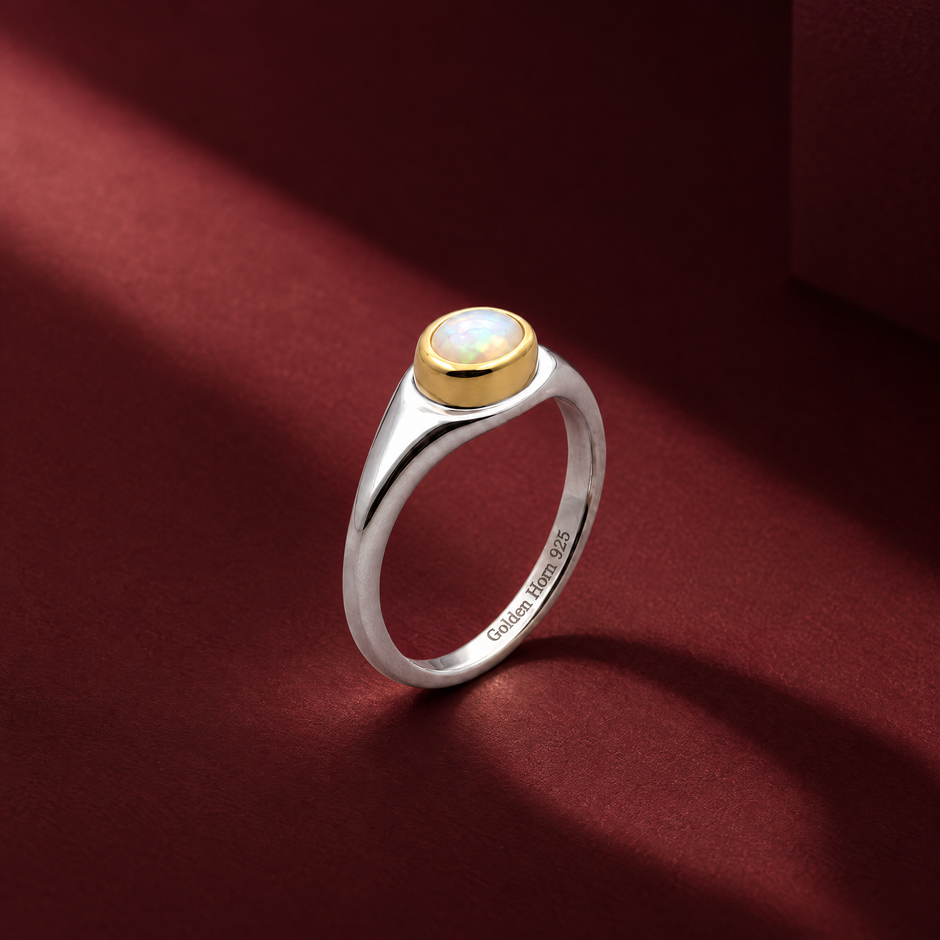
Opal has no crystal structure. It is silica with a little water held inside, and it is known for flashes of colour that shift as the stone turns. It is October's traditional birthstone, and today it is most often associated with creativity and imagination. At about 5.5 to 6.5 it is the softest stone here, so it suits a bracelet worn with some care instead of one that never comes off. It sits next to the moonstone at the centre of the Helen Caramel Moonstone Bracelet.
Aqeeq
Aqeeq, also written akik or aqiq, is the name used in Turkey and across the Middle East for agate and carnelian, both of which are forms of chalcedony. It has been worn in rings and prayer beads in the region for centuries and is traditionally associated with protection and faith. At about 6.5 to 7 on the Mohs scale it is a practical stone for regular wear. It is set at the sides of the Helen Caramel Moonstone Bracelet.
Chalcedony
Chalcedony is quartz made of crystals too small to see, which gives it a smooth, slightly cloudy look instead of sparkle. It has been cut into seals and beads since antiquity and is traditionally associated with calm and goodwill. At about 6.5 to 7 it wears well day to day. The Nefertiti Chalcedony Chain Bracelet uses brown stones, and the Father And Son Chain Bracelet a blue one.
Smoky quartz
Smoky quartz is quartz in shades from pale brown to near black. In Scotland it is known as cairngorm, after the mountains where it was found, and it has long been set in Highland dress jewellery. It is traditionally associated with steadiness and resilience. Quartz is 7 on the Mohs scale, hard enough to resist most everyday scratches. It is the stone in the Sisterhood Smoky Quartz Gold Bangle Bracelet, where its warm brown sits against gold-plated silver.
Pink quartz
Pink quartz, better known as rose quartz, has a soft, cloudy pink colour. It is the stone most widely associated with love and affection. Like smoky quartz it is 7 on the Mohs scale. The Triple Pink Quartz Dome Silver Cuff Bracelet sets it alongside onyx and red coral.
How to choose a gemstone bracelet
- By meaning. Start with what you want the piece to say. Pink quartz for affection, sapphire for loyalty and jade for good fortune are the most widely recognised.
- By birth month. Moonstone belongs to June, sapphire to September and opal to October. Our birthstone guide lists all twelve months.
- By how it will be worn. For a bracelet that stays on most days, choose sapphire, topaz, quartz, chalcedony or jade. Moonstone and opal are better for pieces that come off before the gym or the washing-up.
If a plain piece would suit better, the full bracelets collection also includes silver chains and cuffs without stones.
Caring for a gemstone bracelet
Clean a gemstone bracelet with lukewarm water, a drop of mild soap and a soft cloth, then dry it fully. Put it on after perfume and hand cream, and take it off for swimming, exercise and cleaning. Keep ultrasonic and steam cleaners away from opal and moonstone, and keep opal away from strong heat. Store each bracelet in its own pouch so that harder stones cannot scratch softer ones. Our handmade jewellery care guide covers the silver itself.
Frequently asked questions
Do gemstone meanings have a scientific basis?
No. Gemstone meanings are cultural traditions, built up over centuries of folklore, religion and trade.
Which gemstone is best for a bracelet worn every day?
Harder and tougher stones cope best: sapphire, topaz, smoky and pink quartz, chalcedony and jade. Opal and moonstone can be worn regularly too, but they will stay in better condition if they are taken off for rough tasks.
Is a birthstone the same as a stone's meaning?
Not quite. Birthstones are assigned to months by published lists, which have changed over time and differ a little between countries. A stone's meaning is the older set of associations attached to it. Many stones have both.