Istanbul Artisan Jewellery: From the Grand Bazaar to London
Every Golden Horn piece begins in a workshop off the covered lanes of Istanbul's Grand Bazaar. This is the story of how it gets from there to you.
By Asim Varol4 min read

Ask anyone who has walked the covered lanes of Istanbul's Grand Bazaar what they remember, and the answer is rarely the shopping. It is the sound: the soft, irregular tap of a hammer on silver, coming from somewhere behind a half-open door. That sound is where Golden Horn begins.
We are a London-based jewellery brand, but every piece we sell is made by hand in Istanbul, by silversmiths working in and around the Bazaar's historic workshop quarter. This article is about that journey: what the Grand Bazaar is, why it still matters for jewellery, how the pieces are actually made, and how they reach a customer in Manchester or Margate.
A market that has been making jewellery for five centuries
The Grand Bazaar was founded in the 1450s, shortly after the Ottoman conquest of Constantinople, and it has been trading continuously ever since. Its jewellers' quarter grew up around the bedesten — the stone-vaulted hall at the heart of the market where the most valuable goods were kept — and the craft has been passed down through workshops, families and apprenticeships for generations.
What makes the Bazaar unusual is that it never became a museum. It is still a working ecosystem. In the narrow hans (courtyard buildings) behind the tourist-facing lanes, you find stone setters, casters, engravers, polishers and silversmiths, each specialising in one part of the process and each within a few minutes' walk of the others. A ring can move from a wax model to a finished, stamped piece without leaving the district.
That density of skill is difficult to replicate anywhere else, and it is the reason we make our jewellery there rather than in a factory.
Handmade, not mass-produced: what that actually means
"Handmade" is an over-used word in jewellery. Here is what it means for a Golden Horn piece.
925 sterling silver as the base. Every piece starts as sterling silver — 92.5% pure silver alloyed for strength. Where a design calls for warmth, the silver is finished with 18k gold plating. We never describe our pieces as solid gold, because they are not; they are silver, plated with gold, and we would rather you knew exactly what you are wearing.
Hammering by hand. Many of our textured pieces are hammered on a steel block with a planishing hammer. No two strikes land identically, which is why no two hammered surfaces are quite the same. Look closely at a piece from the Pure Soap Silver Ring family and you will see the maker's rhythm in it.
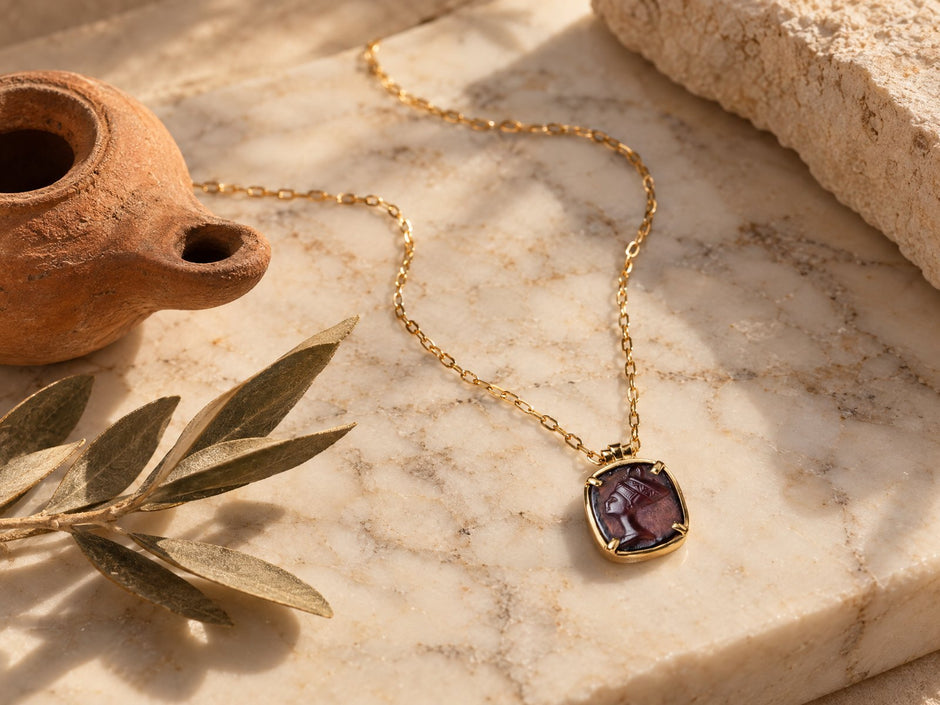
Oxidised and "ancient" finishes. Several of our designs use a deliberately darkened, antiqued finish that sits in the recesses and lets the raised detail catch the light. It is applied by hand, then partially polished back, and it is what gives pieces like the Ancient Medusa Coin Clip-On Pendant the look of something unearthed rather than manufactured.
Stone setting by eye. Our gemstone pieces are set by hand. Natural stones vary in colour, shape and inclusion, so the setter adjusts each bezel or prong to the stone in front of them. This is also why your piece may differ slightly from the photograph — it is a feature of natural materials, not a flaw.
One or two of each. Most of our designs are made in very small numbers. When the last of a design sells, it is usually gone for good.

Symbols from the city itself
A lot of Istanbul's visual language comes from the layers of history that sit on top of one another: Roman, Byzantine, Ottoman, modern. We draw on all of it.
The Ouroboros Snake Silver Bracelet uses a motif that predates the city, the serpent consuming its own tail, as a symbol of renewal. The Patera Bowl Charm is modelled on the shallow libation dishes found across the ancient Mediterranean. Our hamam-inspired pieces — soap, bubble, takunya — come from the Turkish bath culture that is still very much alive a few streets from the workshops.
None of this is decoration for its own sake. The Bazaar has always sold jewellery that means something to the person wearing it, and we try to keep that tradition.

From Istanbul to London: the practical part
Pieces are finished, quality-checked and stamped with the Golden Horn 925 mark in Istanbul, then travel to our stock in London, where they are photographed, listed and dispatched. That is why you will see "handcrafted in Istanbul" and "UK delivery" on the same product page: both are true.
A few things that follow from this model:
- UK delivery is free, and orders ship from London, not from Turkey.
- Returns are accepted within 30 days of delivery; return postage is paid by the customer. Full details are on our Returns & Warranty page.
- Ring sizes are listed in US sizes. If you know your UK letter size, our Ring Size Guide converts it.
- Prices shown on the site are our current Archive Sale prices.
Caring for artisan silver
Handmade sterling silver rewards a little attention. Store pieces separately so they do not scratch one another, keep them away from perfume and swimming pools, and bring the shine back with a soft polishing cloth. Gold-plated pieces should be polished gently and less often, as plating is a surface layer. We have a fuller guide in our jewellery care page.
Why it matters to us
There are faster and cheaper ways to make jewellery. Choosing the Grand Bazaar means accepting slower production, smaller batches and the occasional irregularity of a hand-finished surface. In exchange, every piece carries a little of that hammer sound with it — and supports a craft community that has been doing this work, in the same few streets, for more than five hundred years.
If you would like to see the pieces themselves, start with our New Oneself Hamam collection, which is the most direct expression of the city in our catalogue.